
Headland Hike 2020
Since there are a number of interesting features on Gallan Head it was felt that a leaflet was needed to provide information to visitors about what can be found on the headland when walking around. So a small leaflet was produced titled the Headland Hike, funded by PathsforAll, with assistance for the design and print by Intermedia Services Stornoway.
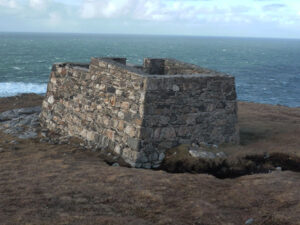
Lookout post
There was some debate as to when it was built and what it was used for. It is a drystone construction and is now believed to have been used as a coastal watching station during wartime and may be described as a Hebridean version of a particular military ‘ Orlit lookout post ‘ design.
A second structure which is very similar to our so-called “lookout” (site 1) has been found somewhere else on the island - at NB 33263 48441, near the village of Bru on the west side, on the top of a hill near a water treatment plant
The idea for these new posts originated in 1947, however, it was only during 1951/52 as part of the programme to update the air defences through the 'Rotor Plan' that more substantial buildings were built to offer at least some level of protection from the elements or attack. Although some of these new structures were built of brick; many sites received pre-cast concrete paneled structures known as“Orlit” posts, after the manufacturers of the structures Messrs Orlit Ltd. These Orlit structures were split into two sections, the entrance door led into the smaller roofed section which was used as a shelter and store with a sliding door into the open section which housed the post instrument and chart on top of a wooden mounting. Two types of Orlit posts existed; the Orlit ‘A’ was at ground level and the Orlit ‘B’ was raised on four 6’0" legs with a ladder for access.
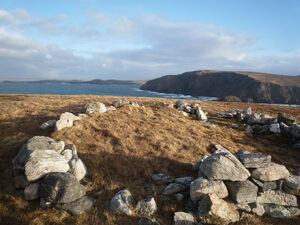
Stone Circle
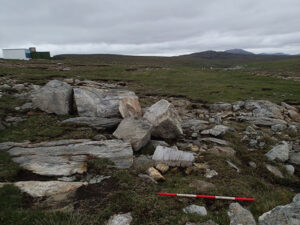
This circular structure of c10m diameter could conceivably be some sort of medieval or post-medieval agricultural enclosure (either to pen animals in or to keep them out so that crops could be grown) but this would not seem appropriate for the location. It is more likely to date from the pre-historic era, Iron Age roundhouses and even Bronze Age Hut.
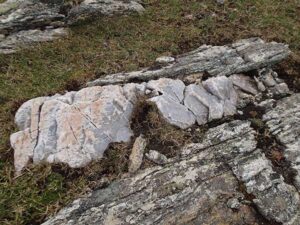
Quartz Seam
There are a number of quartz seams visible on the headland. The quartz is of high quality with few fractures or cracks.
There are marks that resemble circular impact scars, a type of quarry mark from prehistoric quarrying.
Old Well.
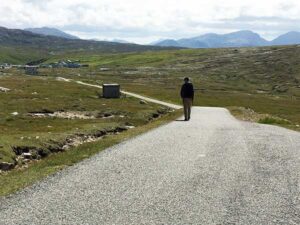
A beautiful stone and mortar built well was discovered not far from the main access road. It was sub rectangular with stone sides around 500mm long with a flagstone and mortar surround area.